Scan to download
BTC $67,088.58 +0.90%
ETH $1,948.25 -0.12%
BNB $605.64 +0.09%
XRP $1.42 -4.56%
SOL $81.67 -4.53%
TRX $0.2795 -0.47%
DOGE $0.0974 -3.83%
ADA $0.2735 -4.22%
BCH $556.77 +0.57%
LINK $8.64 -2.97%
HYPE $28.98 -1.81%
AAVE $122.61 -3.42%
SUI $0.9138 -6.63%
XLM $0.1605 -4.62%
ZEC $260.31 -8.86%
BTC $67,088.58 +0.90%
ETH $1,948.25 -0.12%
BNB $605.64 +0.09%
XRP $1.42 -4.56%
SOL $81.67 -4.53%
TRX $0.2795 -0.47%
DOGE $0.0974 -3.83%
ADA $0.2735 -4.22%
BCH $556.77 +0.57%
LINK $8.64 -2.97%
HYPE $28.98 -1.81%
AAVE $122.61 -3.42%
SUI $0.9138 -6.63%
XLM $0.1605 -4.62%
ZEC $260.31 -8.86%

rollups

Vitalik: Shift in attitude towards supporting native Rollups, ZK timeline gradually maturing

Vitalik Buterin stated that he is "significantly more inclined to support native rollups" compared to the past. Vitalik recalled that a major reason for opposing native rollups previously was that their precompiled solutions had to choose between ZK mode or Optimistic mode, and at that time, ZK-EVM was not mature. L2 often chose the latter, which involved "fast withdrawals but self-proving risks" versus "relying on Ethereum's security but needing to wait 2-7 days for withdrawals," thereby weakening Ethereum's composability and promoting the prevalence of multi-signature bridges and other solutions.Vitalik pointed out that the situation is changing: Ethereum's timeline for fully adopting ZK at the L1 level is gradually aligning with the realistic progress of introducing native rollup precompiles, and the aforementioned core obstacles are expected to be eliminated. He also mentioned that the community is increasingly viewing "synchronous composability" as one of the core values of L2 and is exploring the combination of rollup-based solutions with low-latency pre-confirmation mechanisms.In addition, Vitalik emphasized that the design of native rollup precompiles should not be rushed in its implementation. He expressed a hope that in the future, there would be a property such that if developers build a rollup that is "EVM plus a small amount of extended functionality," they could directly reuse the EVM part of the native rollup precompiles and only introduce a custom proof system for the new features, connecting the two in a standardized way.

Vitalik: Shift in attitude towards supporting native Rollups, ZK timeline gradually matures

Vitalik Buterin stated that he is "significantly more inclined to support native rollups" compared to the past. Vitalik reflected that a key reason for opposing native rollups previously was that their precompiled solutions had to choose between ZK mode or Optimistic mode, and at that time, ZK-EVM was not mature. L2 often chose the latter option, which involved "fast withdrawals but self-bear proof risks" versus "relying on Ethereum's security but needing to wait 2-7 days for withdrawals," thereby weakening Ethereum's composability and promoting the proliferation of multi-signature bridge solutions.Vitalik pointed out that the situation is changing: Ethereum's timeline for fully adopting ZK at the L1 level is gradually aligning with the realistic progress of introducing native rollup precompiles, and the aforementioned core obstacles are expected to be eliminated. He also mentioned that the community is increasingly viewing "synchronous composability" as one of the core values of L2 and is exploring the combination of rollup-based solutions with low-latency pre-confirmation mechanisms.Additionally, Vitalik emphasized that the design of native rollup precompiles should not be rushed in its specific implementation. He expressed a hope that in the future, there would be a property such that if developers build a rollup that is "EVM with a small amount of extended functionality," they can directly reuse the EVM part of the native rollup precompiles and only introduce a custom proof system for the new features, connecting the two in a standardized way.

The Base protocol leader and several Ethereum developers and L2 leaders support based rollups

ChainCatcher news, according to Cointelegraph, Jesse Pollak, head of the Base protocol, recently stated in a conference call with Ethereum founders and developers that based rollups are "a flexible and powerful tool that will allow us to use them for Base, bringing it closer to Ethereum and increasing the security guarantees it provides."Ben Jones, a director at the Optimism Foundation, added that based rollups will improve collaboration between the Ethereum base layer and L2.Ethereum L2 networks (such as Arbitrum, Optimism, and Base) have charged hefty fees by deploying high-speed, centralized sorters (i.e., the order of transaction processing and addition to blockchain blocks), but this comes at the cost of unification.Based rollups, proposed by Ethereum core developer Justin Drake in March 2023, return this process to the base layer, improving the decentralization of the network, as the block building process will be executed by all Ethereum validators rather than a single centralized sorter.At the same time, native rollups will enhance the way transactions are executed on the base layer, making the network more composable.However, these L2s will forfeit a significant portion of their revenue gained through maximum extractable value. Data from Dune Analytics shows that Arbitrum, which supports the transition to based rollups, has generated $210 million in revenue from its centralized sorter, while Base's revenue stands at $96.2 million.It is worth noting that based rollups or native rollups may bring more revenue to Ethereum's base layer and positively impact the price of ETH. However, the decentralized sorting of the Ethereum base layer means that transactions will be confirmed within 12 seconds, rather than the approximately 1 second typical of many Ethereum L2s. Several Ethereum L2 leaders also support the deployment of "FABRIC," an infrastructure that supports based rollups.Daniel Wang, CEO of Ethereum L2 Taiko, stated that the protocol is willing to adopt the FABRIC standard to "address" Ethereum's interoperability issues, saying, "We have been waiting for the FABRIC standard so that we can work together and provide a complete solution."

Vitalik published an article discussing Ethereum L1 and L2 scaling strategies

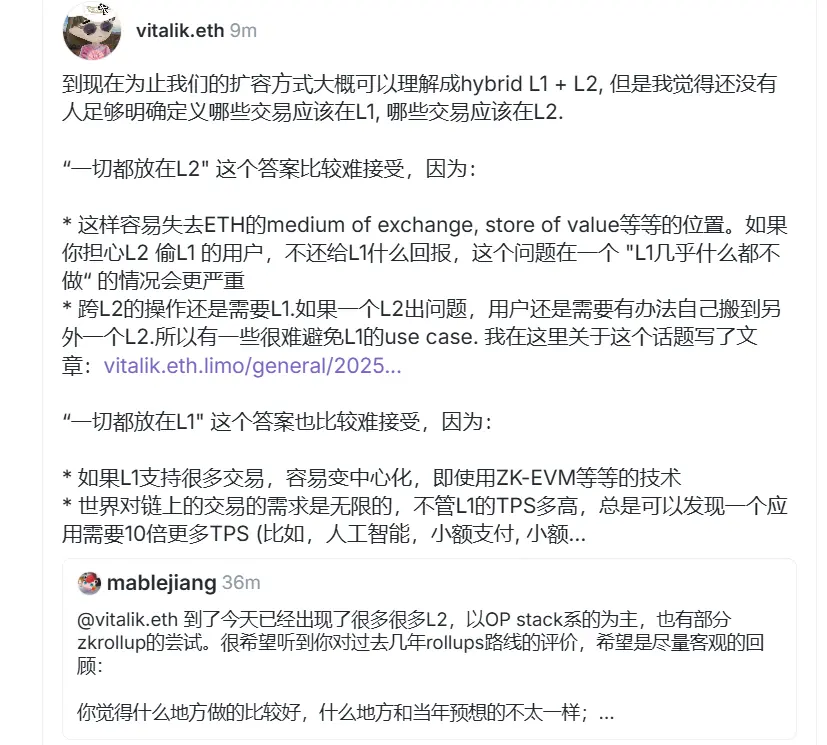
ChainCatcher message, Ethereum co-founder Vitalik Buterin published a blog post stating that Ethereum's goals remain the same as on day one: to build a global, censorship-resistant, permissionless blockchain. After ten years of effort, combining technical and social attributes, Ethereum has embodied another important quality: it provides useful services to people and is capable of achieving this on a large scale.We need to continue building Ethereum's technical and social attributes, as well as its practical utility. I want to focus on a specific impact that is very important for Ethereum users in the short and medium term: Ethereum's scaling strategy.Today, L2 faces two main challenges: scale and heterogeneity challenges. One possible shortcut to scaling is to abandon L2 and complete all operations through L1, significantly increasing the gas limit (which can be achieved through multiple shards or on a single shard). However, this approach would overly compromise many advantages of Ethereum's current social structure, which is particularly effective at simultaneously realizing different forms of research, development, and ecosystem-building culture. Therefore, we should stick to the original path and continue to primarily scale through L2, but ensure that L2 truly fulfills its commitments.Native Rollups are still an early-stage idea. A lot of positive thinking is still needed, especially regarding how to maximize the flexibility of native Rollup precompiles.Now is the time to double down. There are still many areas that require active thinking and brainstorming. The future of Ethereum depends on the active participation of each and every one of us.
app_icon
ChainCatcher Building the Web3 world with innovations.