Scan to download
BTC $72,428.06 +0.93%
ETH $2,223.15 -0.10%
BNB $607.29 +0.23%
XRP $1.36 -0.18%
SOL $84.04 +0.53%
TRX $0.3191 +0.34%
DOGE $0.0929 -0.70%
ADA $0.2559 +0.26%
BCH $444.25 +0.09%
LINK $8.99 -1.04%
HYPE $39.83 +2.74%
AAVE $91.57 -3.16%
SUI $0.9386 +0.55%
XLM $0.1555 -2.76%
ZEC $331.57 +0.59%
BTC $72,428.06 +0.93%
ETH $2,223.15 -0.10%
BNB $607.29 +0.23%
XRP $1.36 -0.18%
SOL $84.04 +0.53%
TRX $0.3191 +0.34%
DOGE $0.0929 -0.70%
ADA $0.2559 +0.26%
BCH $444.25 +0.09%
LINK $8.99 -1.04%
HYPE $39.83 +2.74%
AAVE $91.57 -3.16%
SUI $0.9386 +0.55%
XLM $0.1555 -2.76%
ZEC $331.57 +0.59%

daos

European Central Bank document questions whether DeFi DAOs are sufficiently decentralized

On March 26, the European Central Bank published a working paper studying the governance concentration of four major DeFi protocols: Aave, MakerDAO, Ampleforth, and Uniswap.The paper, based on holding snapshot data from November 2022 and May 2023, found that although governance tokens are distributed across tens of thousands of addresses, the top 100 holders in each protocol control over 80% of the supply, and a large number of governance tokens can be linked to the protocols themselves or centralized and decentralized exchanges, with Binance being the largest identified centralized exchange holder among the four protocols.In terms of voting participation, the paper noted that actual voters are mainly representatives who obtain proxy voting rights from small holders. The top 20 voters in Ampleforth control 96% of the proxy voting rights, the top 10 voters in MakerDAO hold 66%, and the top 18 voters in Uniswap hold 52%. About one-third of the main voters cannot be publicly identified.The paper argues that these findings challenge the assumption of inherent decentralization in DAOs, making it more difficult to determine regulatory anchors under the EU MiCA framework. MiCA currently excludes "fully decentralized" services from its scope. The paper also points out that it is impossible to determine from public data whether the holdings associated with the protocols belong to founders, developers, or treasuries, nor can it be determined whether exchange wallets are voting on behalf of themselves or their clients. The paper represents the authors' views and does not represent the official position of the European Central Bank.

Vitalik: We need more and better DAOs, rather than just treasury controlled by token voting

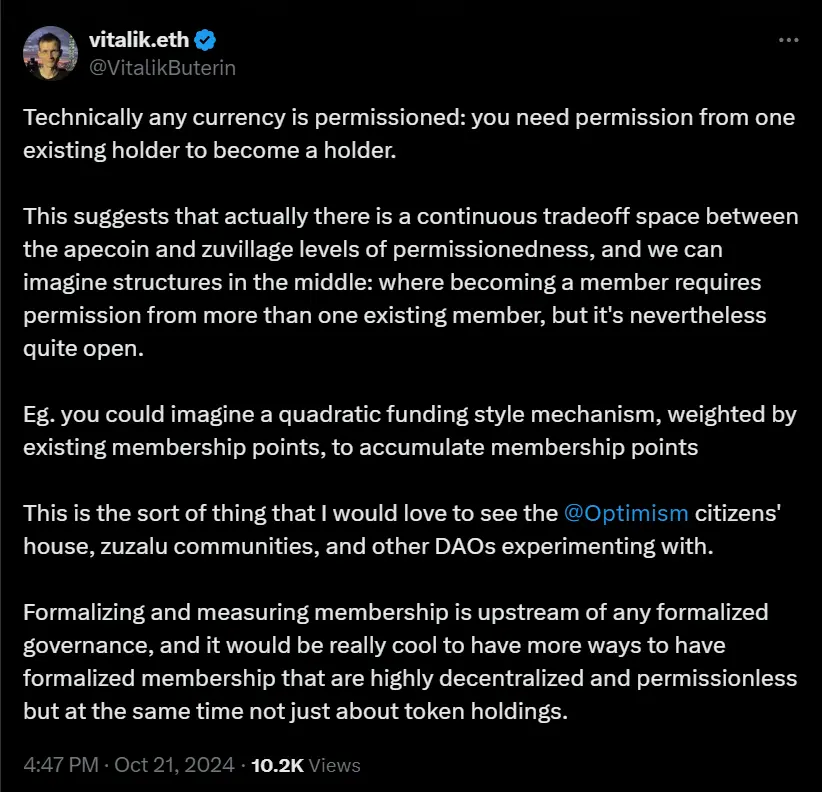
Vitalik Buterin stated that the current practices of DAOs in the crypto industry have deviated from the original vision, and it is necessary to rethink and construct "different and better DAO designs." Vitalik pointed out that Ethereum's initial concept was heavily inspired by decentralized autonomous organizations, but today DAOs are often simplified to "treasuries controlled by token voting." While they may function in form, they are inefficient, easily manipulated, and fail to truly alleviate the issues arising from human political games.Vitalik emphasized that DAOs remain an indispensable infrastructure, with application scenarios including: improving oracle designs, implementing on-chain dispute arbitration, maintaining various critical lists, quickly launching short-term collaborative projects, and supporting long-term project maintenance after the original team exits. He believes that the current problem lies not in the motivations of participants, but in the governance and system designs, such as oracles, which are still inadequate.In terms of governance frameworks, Vitalik introduced an analysis perspective of "concavity and convexity problems," arguing that different types of issues require different governance structures: scenarios leaning towards consensus and robustness should emphasize broad participation and resistance to manipulation; while scenarios requiring decisive decision-making should allow for leadership, balanced by decentralized mechanisms.Vitalik further pointed out that for DAOs to truly function, they must address two major challenges: privacy and decision fatigue, and can leverage privacy technologies such as zero-knowledge proofs (ZK) and multi-party computation, as well as AI and consensus-based communication tools to alleviate governance burdens. He emphasized that AI should not replace human judgment but should serve as a tool to amplify and assist human intentions.Finally, Vitalik stated that future DAO designs need to consider governance mechanisms, privacy technologies, and communication layers as core components rather than auxiliary modules, to ensure that the decentralization and robustness of Ethereum's underlying infrastructure are sustained in its upper-layer applications.
app_icon
ChainCatcher Building the Web3 world with innovations.