



Huobi Growth Academy | In-Depth Research Report on Privacy Coins: Value Reassessment from Anonymous Demand to the Era of Zero-Knowledge Proofs

 This report takes the surge of Zcash (ZEC) as an entry point and systematically sorts out the technological evolution, valuation repricing, and medium- to long-term investment logic of the privacy coin sector. Privacy is not a temporary topic, but a growing necessity for "financial infrastructure" against the backdrop of regulatory technology, CBDC, on-chain monitoring, and data abuse: enterprises need to protect trade secrets, individuals need to prevent their assets and behaviors from being fully profiled, and nations are engaged in a game around data sovereignty.
I. Overview of the Privacy Coin Track
In the structural rotation of the crypto market from 2024 to 2025, one of the most dramatic mainlines is the "revival of privacy coins." After being long suppressed by regulatory pressure, delistings from exchanges, and cooling narratives, the privacy track suddenly returned to the spotlight in the second half of 2025: the overall market value of privacy coins broke through the range of $24 to $28 billion, with Zcash (ZEC) and Monero (XMR) leading the charge, significantly outperforming the broader market. Especially ZEC, which fell below $20 in July 2024, surged to around $600 to $700 in November 2025, with a phase increase of over 30 times, becoming one of the "flag bearers" of this round of privacy sector rally. In this context, privacy coins are no longer just synonymous with "dark web assets" or "compliance gray areas," but have been re-integrated into the medium- to long-term asset pool of "digital financial privacy infrastructure."

Since the birth of Bitcoin, discussions around "privacy" in the digital asset world have never ceased. From the initial pseudonymity to the now complex and diverse privacy protocols, privacy is not an ancillary topic of crypto assets, but a fundamental variable that runs through "financial freedom - regulatory games - data sovereignty." Bitcoin is not a truly anonymous system; all transactions on-chain are public and transparent. By combining KYC data with on-chain clustering analysis, participants' transaction paths, asset distributions, and even identities can be highly reconstructed. As regulatory technology and on-chain evidence collection capabilities rapidly matured between 2020 and 2025, the privacy gaps of public ledgers like Bitcoin and Ethereum were fully exposed, driving the evolution of generations of privacy coins represented by Dash, Monero, Zcash, Grin/Beam, forming an "arms race" in privacy technology. Early privacy solutions mainly relied on mixing and on-chain mixing technologies, such as Dash's PrivateSend, which disrupts transaction paths by mixing inputs and outputs, making it difficult to trace "who paid whom"; Monero achieves triple privacy for sender, receiver, and amount through ring signatures, stealth addresses, and RingCT, continuously expanding "ring size" and using Bulletproofs to reduce transaction size in multiple upgrades. Zcash brought zero-knowledge proofs into the mainstream public chain world, achieving "completely hidden transaction content, only public validity proof" for the first time, with its dual-track design of shielded and transparent addresses allowing users to choose between "privacy and audit." MimbleWimble further elevated privacy to the block level by aggregating transactions and deleting intermediate data, forming a lightweight chain structure that is both private and highly scalable. These technical solutions have never truly targeted "black market tools," but rather respond systematically to three common needs: business confidentiality and pricing privacy, personal asset security, and institutional reflection on "data panoramic surveillance" by states and platforms. The bull market of 2017 pushed the narrative of privacy to its peak, with most privacy coins entering the top twenty by market capitalization, and the market viewed "privacy" as the core competition of the next generation of cryptocurrencies. However, starting in 2018, the track gradually declined under the influence of regulatory pressure, early model flaws, and user accessibility issues. Exchanges gradually delisted strong privacy coins, leading to decreased liquidity; some projects' early designs of high inflation and founder rewards created sustained selling pressure; the high usage threshold of privacy technology itself resulted in actual demand being far less vigorous than speculative demand. By 2023-2024, the privacy track was regarded as a marginal field, with its market capitalization share dropping to less than 1%. However, R&D continued to advance in the shadows: Zcash's NU5/NU6 upgrades removed trusted setups, unified address formats, and introduced Halo 2; Monero continued to optimize ring signatures and privacy proofs; the MimbleWimble community is still exploring lighter and stronger anonymity implementations. The accumulation of technology has not ceased due to price and sentiment, laying the groundwork for the resurgence of the privacy track in 2025. Entering 2024-2025, the macro environment of the crypto market, regulatory orientation, and sector rotation jointly acted, leading to significant changes in the privacy track, with market capitalization rebounding from the bottom to $24 to $28 billion, and the sector regaining institutional attention, even with several research institutions conducting specialized coverage of privacy assets.
At the same time, regulatory pressure and privacy demand are showing a contradictory state of simultaneous rise. The EU AMLR has proposed clear restrictions on "high-anonymity crypto assets," meaning that assets like Monero and Grin, which default to complete privacy, may face a total ban or prohibition from being listed on exchanges in certain jurisdictions starting in 2027. The U.S. Treasury, Justice Department, and on-chain analysis companies have repeatedly tracked and seized large amounts of Bitcoin using machine learning, large-scale address clustering, and behavioral modeling, making "the privacy gap of transparent chains" a social event. The reverse demonstration effect of transparent public chains has instead prompted the market to re-examine the value of privacy coins: in a world where surveillance capabilities are rapidly enhancing, the demand for privacy is no longer a niche characteristic of geeks, but a common concern for ordinary users, institutions, and cross-border enterprises. In this context, privacy assets have shown clear differentiation: Monero represents a path of "strong privacy, un-auditable," where privacy is defaulted but also leads to regulatory resistance and liquidity contraction; Zcash, Secret, and others represent a path of "compliant privacy," which supports shielded transactions while allowing selective disclosure of transaction records through viewing keys, achieving the minimal transparency required for regulation, clearing, and auditing. This design is more likely to gain acceptance from institutions and regulators in policy-friendly areas. The market's revaluation of ZEC largely stems from its technological architecture and compliance attributes being more sustainable in the future privacy policy environment.
Looking ahead to after 2025, the privacy track is completing a historic shift from "privacy coins" to "privacy infrastructure." Privacy is no longer the narrative of a single token but a foundational module of Web3, DeFi, RWA, identity protocols, and financial infrastructure. The future privacy structure will present at least three evolutionary paths. First, compliant privacy will become the mainstream design philosophy. Selective disclosure mechanisms and viewing key models are being seen as viable solutions, allowing institutions to find a new balance between privacy and regulation. Second, privacy will be deeply embedded in DeFi and Web3 in a modular way. In decentralized lending, derivatives, NFTs, on-chain identity, and other fields, users have a strong demand for "position privacy, transaction privacy, asset privacy," and technologies like ZK, MPC, and ring signatures have already begun to enter L2, cross-chain bridges, and application layers. Privacy will shift from L1 competition to "privacy layers for all applications," and may also become a differentiating weapon for L2. Third, privacy will engage in deep games with CBDCs, digital identity systems, and data sovereignty policies globally. Central bank digital currencies face the same problem: how to maintain users' basic financial privacy under anti-money laundering and anti-terrorist financing requirements. Zero-knowledge proofs and selective disclosure mechanisms may be absorbed by central banks, becoming part of their infrastructure. In other words, privacy technology may be suppressed, absorbed, or even become a standard component of the traditional financial system. The revaluation of the privacy track in 2025 is not a product of short-term speculation, but a structural return shaped by "technological maturity × regulatory pressure × market reflection × on-chain monitoring expansion." The long-term value of privacy assets lies not in price fluctuations, but in their response to the core issues of the digital society: when everything can be calculated, audited, and archived, do humans still possess their own "financial space"? The future of privacy is neither dark nor transparent, but a new paradigm that is controllable, authorized, auditable, and not abused. ZEC's standout performance in this round of innovation and compliance trends may be an early signal of this paradigm shift.
II. Analysis of the Investment Value of Privacy Coins
From an investor's perspective, the key question in determining whether a track is worth long-term allocation is never "how much it has risen," but whether the underlying demand is rigid and long-term. The reason privacy coins deserve to be studied as an independent track is that in a world where on-chain finance continues to expand, "privacy" itself is transitioning from an option to a necessity. As long as you have stable use cases on public chains, once a main address is linked to a real identity (for example, by depositing to a KYC exchange or leaving cross-trace during OTC transactions), your entire historical transactions, position sizes, and fund flows may be algorithmically profiled, which means higher attack risks and strategy exposure for high-net-worth individuals, institutional funds, and professional traders: hackers or ransomware attacks can selectively target "large addresses," and counterparties can reverse-engineer your position structure and liquidation thresholds through on-chain intelligence. Privacy coins provide investors with a technical path to "regain financial privacy" in the public financial system through address anonymity, amount hiding, and path obfuscation. In B2B, supply chain finance, and other enterprise scenarios, transaction terms are often extremely sensitive. If all settlement information is exposed on-chain, it not only easily triggers perceptions of "unfair pricing" among customers but can also be used by competitors to reverse-engineer your cost structure and bargaining power. Therefore, building a settlement network that is "auditable to regulators but opaque to the entire network" is a rigid demand for enterprises. At a more macro social level, cases of privacy data breaches and platforms abusing user data are rampant, and the public has gradually realized that "data is an asset." Once leaked, it can be permanently copied, bought, and reorganized, often without users even knowing how their data is being used. In this context, the sentiment of "I hope my assets and transaction records are not exploited endlessly by platforms and third parties" provides deep value and cultural soil for the privacy track. As on-chain monitoring continues to mature, "blacklist coins" and "contaminated addresses" have also become a reality—once an address is associated with hackers or sanction lists, its corresponding assets, even after multiple transfers, may be refused or frozen, causing substantial harm to asset fungibility. Privacy coins combat "address discrimination" by weakening path traceability. Further tracing back to the underlying values, privacy is regarded as a fundamental human right in many societies with strong liberal traditions: "What I choose to disclose and to whom should be my own decision." Privacy coins and zero-knowledge infrastructure can be understood as a technical mapping of this concept in the financial domain. Therefore, as long as the digitization and on-chainization of assets and identities continue to advance, the demand for privacy will not disappear but will emerge in a more systematic way. This determines the legitimacy of long-term research and strategic allocation in the privacy coin track, rather than a one-time thematic speculation.
From a technical lineage perspective, the privacy track can be roughly broken down into several schools and representative assets: CoinJoin/mixing solutions represented by Dash are more like a one-time mixing tool layered on top of existing transparent ledgers, with limited privacy strength; Monero, represented by ring signatures + ring confidential transactions, achieves deep privacy that is mandatory and defaulted through ring signatures, stealth addresses, and amount hiding, serving as the technical home for "pure anonymous advocates"; the zk-SNARKs route represented by Zcash, supported by zero-knowledge proofs, completely hides transaction content, only publicly disclosing validity proofs, and can extend to smart contracts and a broader ZK ecosystem; the MimbleWimble system (such as Grin, Beam) leans towards minimalist protocols and lightweight ledgers, emphasizing block-level aggregation and data pruning, seeking a dynamic balance between privacy and scalability. In this landscape, Monero is the most consensus-driven leader on the strong privacy side, with the largest anonymous set and the richest practical experience, thus naturally becoming a focus of regulatory attention; DASH is positioned closer to "digital cash + light privacy features," gaining some adoption in emerging markets due to its payment experience; the new generation of ZK projects attempts to bind privacy capabilities with L2 scaling and ecological narratives. From a structural position, ZEC stands at a very delicate yet highly elastic midpoint: on one hand, it is technically clearly ahead of simple mixing solutions and more mature and stable than some MimbleWimble projects; on the other hand, its privacy strength, while not as strong as Monero's mandatory ring signatures, provides a more natural design space for "privacy + audit + compliance" through its dual-track model of transparent and shielded addresses, as well as mechanisms like viewing keys. Coupled with a series of upgrades like Halo 2, Orchard, NU5/NU6, it leads in "removing trusted setups, unifying address structures, and lowering the barriers to privacy transactions." ZEC is not only a privacy coin itself but is also beginning to play the role of a "zero-knowledge technology supplier," with the research results of zero-knowledge proofs having spillover effects on the broader Web3 and ZK Rollup ecosystem. From an investor's perspective, ZEC can be understood as a typical "high-beta leader": enjoying the beta of the entire privacy track while gaining additional alpha through its technological moat and compliance imagination.
The surge of ZEC in 2024-2025 is not driven by a single catalyst but is the result of a series of medium- to long-term variables converging within the same time window. First, from the supply and valuation perspective, Zcash continues the total supply and halving curve similar to Bitcoin. After years of price decline and emotional cooling, the second halving in 2024 will further compress the block reward to 1.5625 ZEC, significantly reducing the inflation rate, decreasing the sellable chips for miners, and synchronously lowering the number of ZEC received by the developer fund. In the previous years, "founder's rewards/developer funds" were widely seen as a source of continuous selling pressure, but after multiple rounds of halving, the marginal impact of this negative factor began to weaken. Combined with the historical bottom price of $15 to $20, it is equivalent to compressing the spring to its limit on the supply and valuation side. When sentiment and funds return to this sector, the upward elasticity of the price is greatly amplified. Second, the "qualitative change" brought by technological and product upgrades: removing trusted setups, improving the efficiency of privacy proofs, unifying address models, and enhancing the experience of light wallets and mobile terminals have shifted external understanding of ZEC from "an old privacy coin" to "a candidate for privacy infrastructure that can be adopted by financial institutions and compliant products." The technical narrative is no longer confined to white papers but is concretely implemented at the network and user experience levels. Third, the linkage between narrative and funding structure: as the overall market capitalization of privacy coins rebounded above $20 billion, multiple research and media outlets marked ZEC as the "leader of privacy revival," along with some institutional product holdings disclosures, making "institutional recognition" a new label. In the derivatives market, ZEC perpetual and options trading volumes surged sharply when breaking key price levels, triggering short squeezes multiple times and pushing prices up in a nearly waterfall-like manner. Subsequently, funds rotated within the sector towards assets like XMR and DASH, forming a complete "privacy coin sector rally." Finally, macro and regulatory events provided strong narrative fuel for this round of rally: several large BTC tracking and seizure cases on transparent public chains made the market intuitively feel that public ledgers have almost no "forgetting space" in the face of strong regulation and strong analytical capabilities, which not only strengthened regulatory confidence but also intensified some users' concerns about their privacy being completely stripped away. In this contrast, assets that can provide strong privacy while having selective disclosure capabilities are naturally seen as tools to hedge against the risks of transparent chains and the excessive visibility of future CBDCs.
However, understanding the logic behind ZEC's surge does not mean ignoring its risk attributes. The privacy track as a whole has characteristics of high volatility, high policy sensitivity, and high narrative dependence; the greater the increase, the higher the sensitivity to regulatory and liquidity shocks. Therefore, compared to "going all in on a single coin," a more reasonable perspective is to incorporate the privacy track into a structured allocation at the portfolio level. It can be viewed as a functional sub-allocation within a digital asset portfolio: on one hand, it hedges the tail risk of "privacy being further compressed" in the macro and regulatory environment, and on the other hand, it shares the long-term beta generated during the gradual absorption of zero-knowledge proofs and privacy infrastructure by traditional finance and Web3. In specific allocation, investors can understand it using a "core + satellite + options" three-layer structure: using XMR and ZEC as the core layer leaders, one leaning towards extreme privacy and the other towards compliance imagination; using privacy assets with actual adoption in payment-oriented or specific regions as the satellite layer, focusing more on actual use cases and network effects; and using emerging ZK/L2/privacy DeFi modules as the options layer, taking small positions to bet on technological inflection points and narrative amplification for high returns. Regardless of the structure adopted, the premise is a clear understanding of the high volatility and policy uncertainty of the track, incorporating both "long-term optimism for privacy" and "short-term respect for risk" into the investment framework through position control, stop-loss mechanisms, and regular rebalancing. For investors willing to invest time in deep research and understanding the technological and regulatory games, the privacy coin track, especially the compliant privacy architecture represented by ZEC, may be one of the main lines running through the bull and bear markets of digital assets in the future. However, it is more suitable to be rationally and systematically incorporated into a portfolio rather than impulsively betting driven by emotions and short-term price increases.
III. Investment Prospects and Risks of the Privacy Coin Track
The medium- to long-term prospects and risk structure of the privacy coin track are rapidly reshaping with the deepening of digitalization, changes in the regulatory environment, and the maturation of cryptographic infrastructure. From the perspectives of macro trends, technical routes, and institutional adoption paths, the value logic of privacy assets is moving away from the category of "speculative niche coins" and evolving into a long-term proposition that spans business, finance, sovereignty, and internet architecture. In a world where assets, identities, and data are gradually being put on-chain, privacy is no longer optional but is gradually becoming a fundamental need. Therefore, the cryptographic privacy infrastructure represented by privacy coins may form a structural growth pillar in the next decade.
From the changes in the real world, the awareness of privacy and data sovereignty among enterprises, individuals, and nations is synchronously rising. For enterprises, business secrets, cost structures, supply chain pricing, and credit terms are all highly sensitive data. If the settlement and clearing processes are completely transparent, it means that competitors can easily reverse-engineer cost structures and strategic arrangements through on-chain data, creating new asymmetric competition. For individuals, information leaks and data abuses have long become the norm, from social media and ticketing platforms to large internet companies. The public is gradually realizing that financial trajectories, asset scales, and transaction habits themselves are extremely valuable "invisible assets," and exposure means higher attack risks. With the promotion of infrastructures like CBDCs, digital identities, and unified credit systems, discussions around data sovereignty between states and citizens are becoming increasingly heated. All these trends collectively drive privacy from being an "optional" to a "fundamental infrastructure demand," placing privacy coins and privacy protocols at the intersection of this trend. Meanwhile, the maturation of cryptographic technologies such as zero-knowledge proofs, ring signatures, and multi-party computation is accelerating the trend of privacy transforming from "a characteristic of a certain chain" to "a component of Web3 full-stack infrastructure." For example, the zero-knowledge proof research promoted by projects like ZEC, Aztec, and ZK Rollup has penetrated into many directions such as privacy payments, on-chain settlements, RWA data protection, ZK KYC, and ZK reputation. Even if the price of a single privacy coin does not rise in the future, its underlying technology will still be adopted in broader B2B and B2G scenarios through enterprise solutions, sidechains, and permissioned networks. In other words, even if investors do not directly hold privacy coins themselves, the value of the privacy track may still be realized through technological spillover.
Furthermore, driven by the global institutionalization of DeFi, the demand for privacy is evolving from "anonymous transactions" to "selective transparency." Institutions want to monitor systemic risks and overall on-chain leverage but do not want their positions, strategies, and liquidity exposed to competitors; high-net-worth clients also wish to utilize on-chain settlements and 24/7 liquidity without having their asset scales fully disclosed by on-chain scanning tools. With the emergence of products like on-chain government bonds, money market funds, and institutional lending pools, a financial network that is "auditable but not completely transparent" is gradually taking shape. Privacy chains, privacy L2s, and privacy modules thus have the potential to be adopted as infrastructure by financial institutions. The future of privacy is no longer limited to niche narratives but is becoming an "optional transparency layer" for institutions. In this sense, the privacy track has a long-term growth pillar that can span bull and bear cycles. However, the privacy coin track is not without risks, with the most core systemic risk stemming from changes in the regulatory environment. In recent years, privacy coins have been in a "gray area": they are essentially technical tools that provide privacy, not exclusive carriers for illegal purposes, but regulators often associate privacy-enhancing tools with illegal fund flows. The EU AMLR has explicitly included highly anonymous crypto assets as key regulatory targets, and some regions are discussing banning privacy coins from being listed on local exchanges; countries like the U.S. also do not rule out taking more direct sanctions against mixers, anonymous wallets, or certain privacy protocols. In this context, "compliant privacy" itself is a dynamic game: whether regulators accept mechanisms like ZEC's viewing keys and whether financial institutions are willing to adopt "selective disclosure" models will require time for validation. If major jurisdictions implement more aggressive restrictions, the entire privacy track may experience a sharp valuation correction in the short term.
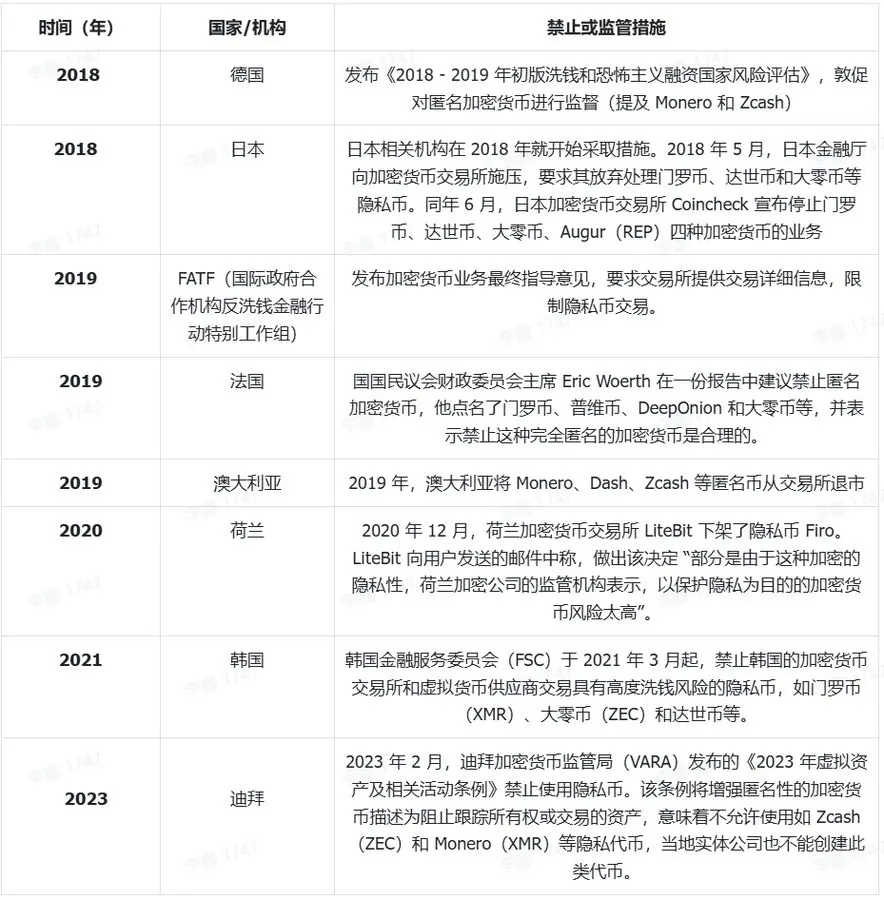
Technical risks are also not to be overlooked. Privacy protocols are highly dependent on the correct implementation of cryptography; any underlying algorithm bug, risks in the zero-knowledge proof parameter generation process, errors in wallet default settings, or even misuse of privacy switches by clients can weaken or even destroy anonymity. Moreover, the attack surface of privacy protocols is more complex than that of general public chains, and many users do not understand that "privacy protection is not absolute," which increases security uncertainties at both the usage and implementation levels. Therefore, the security of privacy assets should not be taken for granted as a technical gift but requires continuous attention to project audits, upgrade rhythms, and community transparency.
The privacy track also faces competitive pressures from both internal and external sources. As Ethereum and its L2s (such as zkSync, Stark series), Bitcoin sidechains, and high-performance public chains all join the research and development of zero-knowledge proofs, privacy capabilities are gradually "sinking" into mainstream public chains. This means that in the future, privacy may become a "general function" rather than the exclusive selling point of "independent privacy coins." The final landscape may evolve into two categories: one is dedicated privacy coins like XMR and ZEC, serving as pure choices for privacy advocates; the other is privacy modules of mainstream chains that provide sufficient privacy protection for 90% of use cases. From a valuation perspective, this means that whether privacy coins can maintain high market values depends on factors such as ecosystem, use cases, and institutional adoption, rather than solely relying on "having privacy technology" as a moat.
Finally, liquidity and market structure remain the most immediate risks for privacy coins. Compared to BTC and ETH, the overall market capitalization of privacy coins is smaller, more concentrated, and lacks depth, making it easier to trigger severe price fluctuations when large funds enter or exit. Insufficient depth in the derivatives market may also strengthen the effects of long and short squeezes; some exchanges taking delisting measures or temporary risk control adjustments may cause severe price shocks. In other words, even if the long-term logic of the privacy track holds, it is still not an asset category suitable for high leverage and heavy bets. In summary, the privacy track has clear medium- to long-term growth pillars: the certainty of privacy demand, the spillover of zero-knowledge technology, and the deep coupling potential with institutional finance; at the same time, it faces systemic risks from regulation, technical implementation, competitive environments, and market structures. The future of privacy coins should not be overly optimistic, nor should it be intimidated by short-term price behavior. The key is to understand the strategic value they represent as "the privacy infrastructure layer of the future on-chain world" and to allocate this track using portfolio thinking, risk budgeting, and long-term tracking. In an era of increasing transparency, privacy will become even scarcer and more important, making the investment value of the privacy coin track ultimately depend on whether investors can view it from an infrastructure perspective rather than a short-term volatility perspective.
IV. Conclusion
Privacy coins are not a short-term hot topic but are gradually becoming a structural necessity in the financial system against the backdrop of deepening digitalization, maturing regulatory technology, advancing CBDCs, and frequent data abuses. Privacy is bound to transition from a marginal issue to a public issue, and its realization may continuously evolve between privacy coins like XMR and ZEC and ZK Rollups, privacy L2s, and compliant privacy modules, but the long-term trend of "expansion of privacy infrastructure" is already clear. The recent surge of ZEC is attributed to supply contraction, long-term undervaluation, and technological upgrades like Halo 2 / NU5, as well as the influence of high leverage and emotional amplification in the crypto market, making linear price extensions impossible. The key lies in observing whether ZEC continues to increase the proportion of shielded transactions and actual usage during the correction period and stabilizes its strategic position of "compliant privacy" in the regulatory game. For investors, the privacy track is more suitable as a functional sub-allocation within a portfolio to hedge against the risks of transparent public chains and CBDCs while sharing the long-term beta generated by the popularization of privacy technology, rather than a single heavy bet. It should focus on leading assets, supplemented by small positions in innovative projects, while continuously tracking regulatory developments, project progress, and on-chain data. This report aims to provide a cognitive framework rather than buy/sell signals. In the next decade, the privacy track will still experience multiple rounds of enthusiasm and suppression cycles. What truly matters is maintaining judgment amidst volatility and narratives, viewing "privacy" as an inevitable value of infrastructure from a long-term perspective.
 Risk warning Risk warning

Popular articles